
Autores
Israel Escudero-Castillo, Fco. Javier Mato-Díaz, Ana Rodríguez-Álvarez (University of Oviedo)
What happens to a person’s psychological wellbeing when their partner loses their job? It has long been known that unemployment can have negative consequences that go far beyond the loss of income. Losing a job also means losing routines, social relationships, recognition and, in many cases, part of one’s own identity. However, we know considerably less about how far these consequences extend to those who live with an unemployed person. Our results for Spain suggest that they do, but in a markedly unequal way: male unemployment is associated with a deterioration in the psychological wellbeing of the female partners, whereas no equivalent association is found when the unemployed person is the woman. The presence of children is, moreover, fundamental to understanding these differences.
Spain is a particularly interesting case for studying this question. Unemployment has been persistently high, and there is still a significant gap between men and women in labour market participation, unemployment, wages, temporary employment and part-time work. At the same time, the family plays a particularly important role as a source of economic and emotional support, while domestic and caring responsibilities continue to be distributed unequally between men and women.
In an article recently published in the International Journal of Health Economics and Management, we analyse the relationship between unemployment and psychological wellbeing by incorporating precisely this family dimension. We use the 2006, 2011 and 2017 editions of the National Health Survey combining individual and household information. To assess gender differences within the couple, we restrict the sample to different-sex couples, excluding same-sex couples. The final sample consists of 16,311 economically active people who live with a partner who is also active in the labour market.
Psychological wellbeing is measured using the General Health Questionnaire (GHQ-12), one of the most widely used instruments for detecting psychological distress. Its score ranges from 0 to 12: the higher the score, the worse the psychological wellbeing.
Unemployment matters, but not in the same way for everyone
The results first confirm the negative relationship between unemployment and psychological wellbeing. For the sample as a whole, being unemployed raises the GHQ-12 score by around 1.4 points. But this overall result hides important differences between men and women.
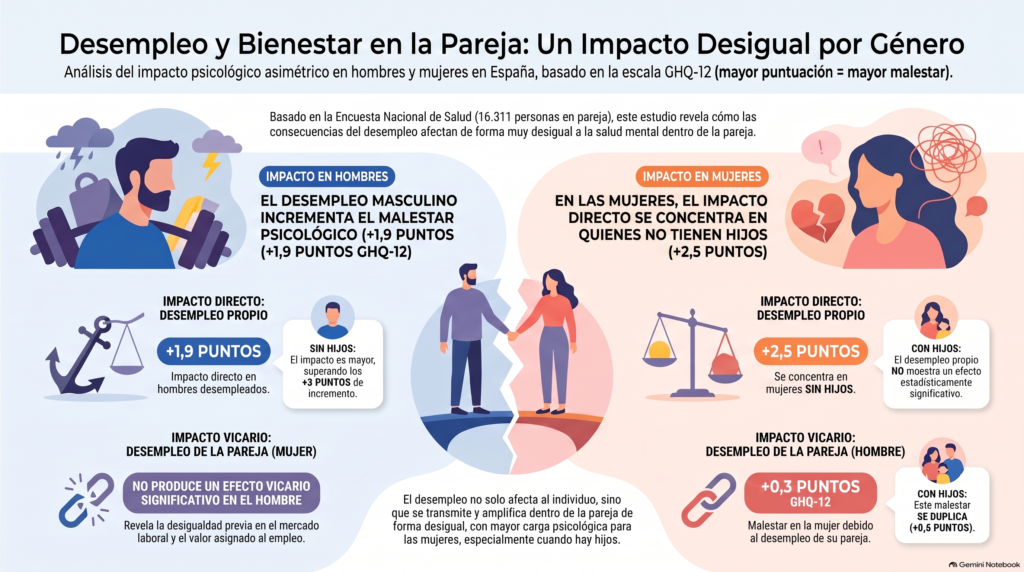
Among men, unemployment raises the GHQ-12 score by around 1.9 points. For women as a whole, by contrast, the estimated effect is not statistically significant. The immediate question is whether this means that women are somehow more protected from the psychological consequences of unemployment. The answer becomes considerably more interesting once the presence of children is taken into account.
Children change the picture
Among men, unemployment is associated with worse psychological wellbeing whether or not they have children in the household. The magnitude, however, is very different: the estimated increase in the GHQ-12 is around 1.2 points among men with children and exceeds 3 points among those without.
Among women, a different pattern emerges. For women with children in the household, we find no statistically significant relationship between their own unemployment and psychological wellbeing. Among women without children, however, unemployment raises the GHQ-12 by more than 2.5 points. These differences should not be interpreted as a causal effect of having children. They do show, however, that the relationship between unemployment and psychological wellbeing differs greatly depending on family circumstances, and that ignoring them could hide an important part of reality. Graph 1 includes all the coefficients obtained in the estimation of the direct effect of unemployment.
Graph 1-Estimated coefficients of the direct effect of unemployment
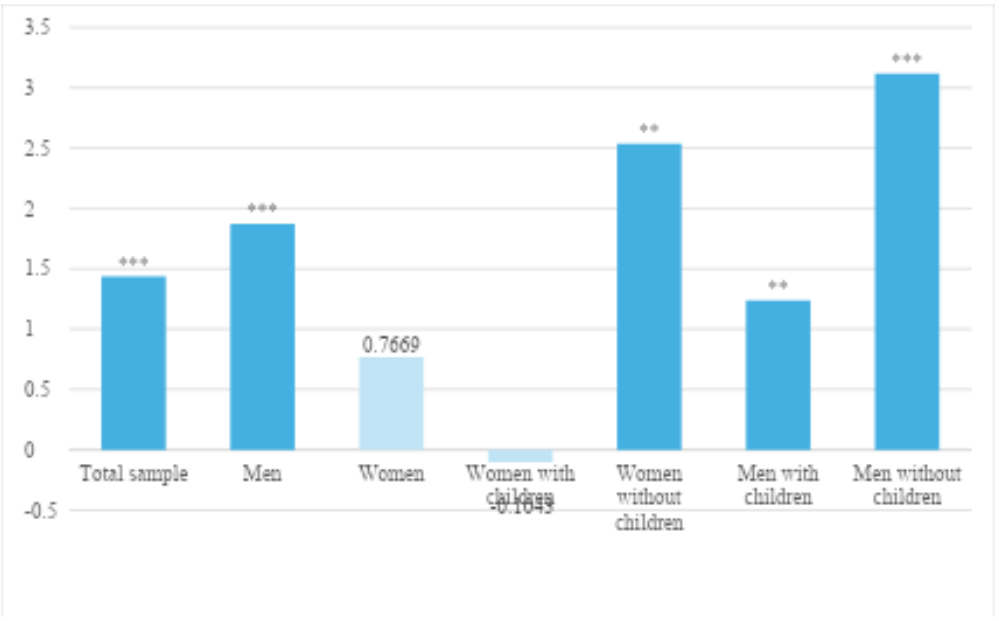
***Statistical significance: 1%; **Statistical significance: 5%.
Source: authors’ own elaboration
And what happens when the partner is the one out of work?
Let us now return to the question that opened this post: what happens when it is not you, but your partner, who is unemployed?
In the sample as a whole, living with an unemployed person is associated with a deterioration in psychological wellbeing. But, once again, the average hides a marked gender difference.
When the man is unemployed, we find a statistically significant association with the psychological wellbeing of his female partner: having an unemployed male partner is associated with an increase of around 0.3 points in the GHQ-12 score. When the unemployed person is the woman, by contrast, we find no statistically significant association with the psychological wellbeing of her male partner.
And children change the picture again, though differently, depending once more on the sex of the unemployed person. The association between male unemployment and lower wellbeing for the woman appears among couples with children: in this group, the man’s unemployment is associated with an increase of almost 0.6 points in his partner’s GHQ-12. However, the association between female unemployment and the psychological wellbeing of their male partners is not statistically significant. Graph 2 includes the coefficients from the estimation of the vicarious effect.
Graph 2-Estimated coefficients of the vicarious effect of unemployment
***Statistical significance: 1%; **Statistical significance: 5%.
Source: authors’ own elaboration
An important caveat applies here. Our econometric strategy is based on an instrumental variables model estimated by two-stage least squares to address the potential bidirectional causality between a person’s own unemployment and their psychological wellbeing, which provides a firmer basis for interpreting that result in causal terms. However, we cannot do the same with the partner’s employment status. Therefore, these «vicarious» effects should be interpreted as associations and not as demonstrated causal effects.
A female advantage? Probably not
One possible interpretation of these results would be to conclude that women, and particularly mothers, are more protected against the psychological effects of unemployment. However, this interpretation may be too optimistic.
Our results are also compatible with another explanation. On average, women continue to occupy a different position from men, both in the labour market and within the household. In our sample, they are more likely to experience precarious working conditions and reduced working hours, and they take on a much greater share of caring responsibilities. These differences may help explain why the presence of children is associated with different patterns in the relationship between unemployment and the psychological wellbeing of men and women.
If paid employment provides not only income but also social recognition, identity, autonomy and personal fulfilment, losing it can have different consequences depending on the role work plays in each person’s life: for those in a more disadvantaged position in the labour market, losing a job will affect their psychological wellbeing less than for those in more favourable positions. Since in Spain it is generally women who are disadvantaged in the labour market, it is logical to think that both results, the more disadvantaged position in the labour market and a smaller deterioration in wellbeing in the face of unemployment, could be related. Likewise, if the contribution of men and women to the labour market and to care work remains different, the consequences of each person’s unemployment may also differ for their partner. The presence of children in the household may push women further out of the labour market and reinforce their role as carers, thereby increasing their labour market disadvantages. In sum, the weaker association between women’s employment and the psychological wellbeing may reflect the lower social value attributed to women’s employment.
Consequently, women’s apparent lower vulnerability to unemployment could be the manifestation of a prior inequality rather than an advantage.
From the individual to the household
Finally, the results point towards a more general conclusion. To adequately understand the costs of unemployment, it is not enough to look at what happens to the person who loses their job.
Unemployment can also affect the wellbeing of those who live with that person. And the way these effects are distributed within the household appears to be related to gender and the presence of children.
The consequences of unemployment, therefore, extend beyond the labour market. They affect mental health and can spill over from one person to another within the family. Incorporating this family dimension is relevant both for better understanding the real costs of unemployment and for designing employment and mental health policies that take into account that behind every employment situation there is, often, a household.